
Scott Joplin, 1902
The Entertainer
A rag for solo piano
Orchestral music
Every work starts as a written score, and recordings of real musicians play it. None of it is generated.
Sognata is in private preview.
Every note is written down first.
A real instrument plays each one.
And every note is drawn as it sounds.
Scroll to play
Sognata isn't an AI music generator, and nobody types a prompt to get a song. Each work is written as a score first, part by part, and that score is what you hear.
The films are drawn from the score as it plays. In the Round turns a piece into a turning disc, and Keyfall drops each note onto a keyboard as it sounds.
The orchestra is made of recordings of real musicians playing real instruments. Each part plays its own line of the score, with the articulation that line asks for, such as legato or pizzicato.
Sognata does the work of a DAW and a sample player in one. It reads the score, plays each instrument's recordings, then mixes and masters the result.
Before the concert
The oboe gives the A, the strings tune in fifths, everyone practises at once, and then the whole orchestra settles on one note. It's written as a score like everything here, so you can switch each section on and off while it plays.

From the public domain
Two pieces, each performed from its score and drawn as it plays. Scott Joplin's rag falls onto the keys, and the first movement of Vivaldi's Spring turns on the disc.
Scott Joplin, 1902
A rag for solo piano

Antonio Vivaldi, 1725
Allegro, for solo violin and strings
A generated track arrives as finished audio. You can ask for another take, but you can't fix one bar in the middle, change a single note, or turn it into parts a musician can play. Its harmony is whatever the model guessed.
Sognata works from real arrangements: scores that people and agents both write in, and that musicians can read.
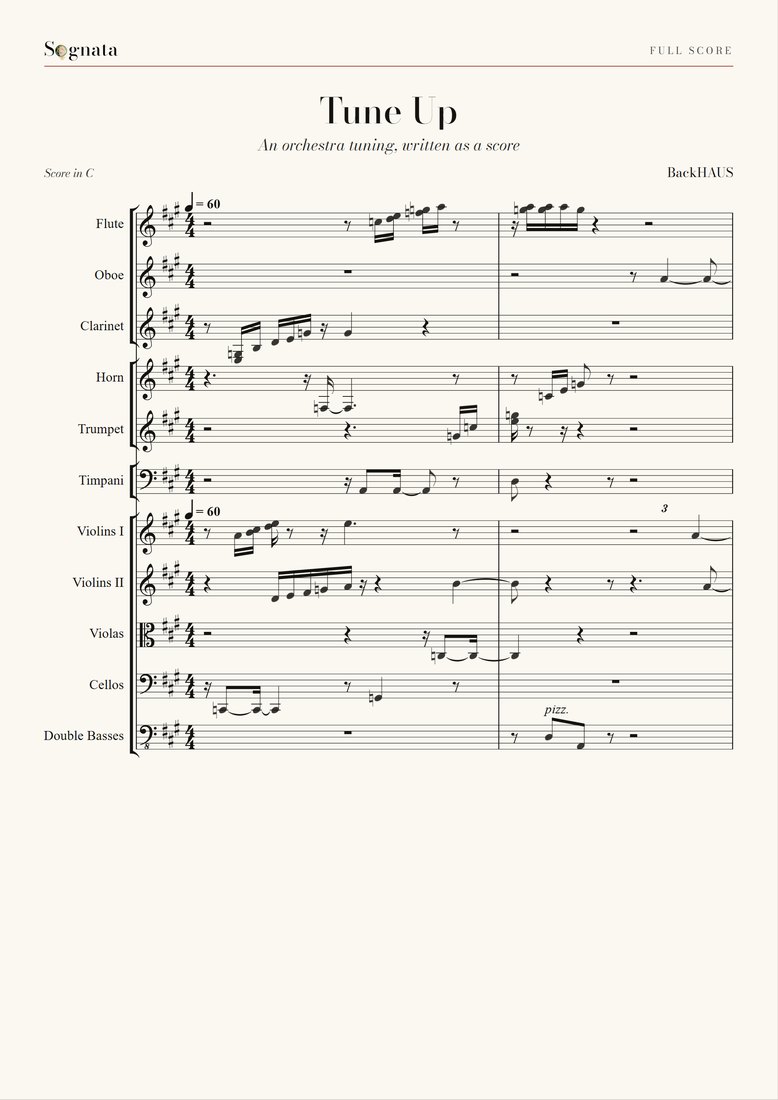
Every note, dynamic and tempo is written down, so you can fix one bar and leave the rest of the piece exactly as it was.
Ask for what you'd ask a musician: softer here, held longer there, a different voicing in bar 12. Each request becomes a change to the score.
The score prints as sheet music, as a full score or as parts for each player, so the piece can go straight to a real ensemble.
Harmony and voice-leading are written out on the page, where a musician can read and question every chord.
A theme written once can return across a whole project, in a new key, tempo or orchestration, because it lives in the score as notes. A generated track can't carry its motif into the next one.
The recording, the film and the sheet music all come from the same score. Change a note and all three are made again from it.
The first films and scores are coming soon.
BackHAUS writes the music for its games with Sognata.
Musicians use it to test the scores they compose, with every part played by recorded instruments.
About
Sognata is Italian for "dreamed", and it sits one letter away from sonata. A piece starts as music someone hears in their head. Sognata carries it from there to a written score, a performance and a film.
The logo is set at night for the same reason. The "o" is the turning disc from the films, drawn as a moon: the lit side holds the music already heard, the dark side holds the parts still to come, and the note playing now sits on the line between them.
Sognata is a studio project by BackHAUS. Sognata is in private preview. BackHAUS